IELTS Speaking Tips PDF: free download and practical guide
These tips are organised the way the test is: what to do in Part 1, Part 2 and Part 3, how to improve against each of the four marking criteria, and which mistakes cost candidates the most. Each tip is something you can practise today—try it straight away in the free speaking mock test.
Keep a printable speaking guide beside your practice
Original Part 1, Part 2 and Part 3 strategies, worked examples and a self-review plan. Free PDF, no login, no email gate. Print it or save it offline. This is independent practice material, not official questions or a band-score promise.
Download the free speaking tips PDF
Browse all free Speaking PDFs or put one tip into practice with the free timer. Recording is optional.
Preview the printable tips PDF
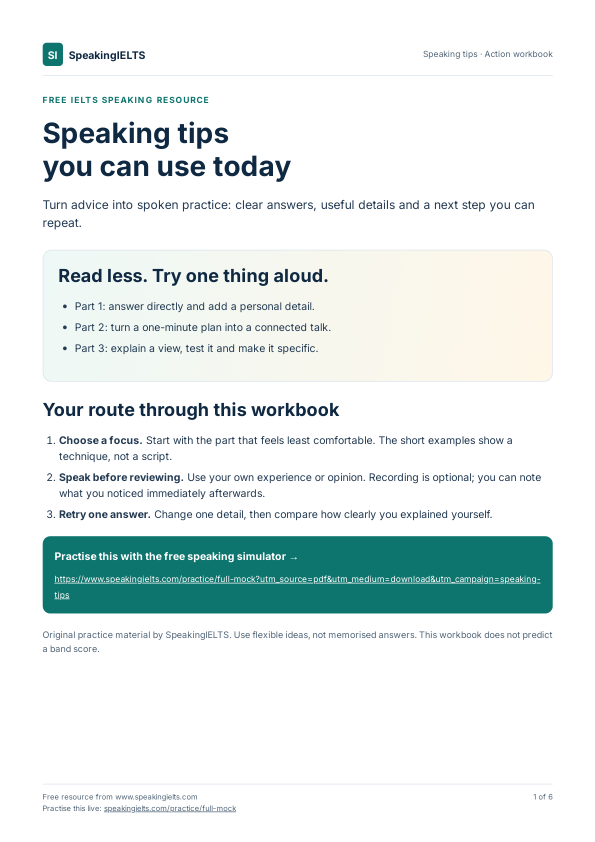
Start directly in Part 1, plan keywords for Part 2, develop a reason and example in Part 3, then choose one change for your next session.
Download a free printable speaking worksheet to practise these strategies.
How IELTS Speaking is marked
The Speaking test is an 11–14 minute conversation with an examiner in three parts. You are assessed on four equally weighted criteria: fluency and coherence, lexical resource (vocabulary), grammatical range and accuracy, and pronunciation. Every tip below targets at least one of them. Nothing on this page can guarantee a band score—but regular practice with these habits makes the test feel familiar.
IELTS Speaking Part 1 tips
Part 1 lasts four to five minutes: short questions about you, your home, work or studies, and everyday topics.
1. Answer, then extend
Give a direct answer, then add one reason, detail or example. “Yes, I do. I usually cook at the weekend because it's the only time I'm not rushing—last Saturday I made…” Two to four sentences is the right length.
2. Avoid one-word and memorised answers
“Yes” gives the examiner nothing to assess; a recited paragraph sounds unnatural. Aim for the middle: relaxed, conversational and specific.
3. Use the tense the question uses
“Did you enjoy school?” needs past forms; “Will you live there in the future?” needs future forms. Matching tenses is an easy way to show grammatical control.
4. Paraphrase instead of repeating the question
If asked “Do you like reading?”, try “I'm a big fan of books, especially…” rather than “Yes, I like reading.”
5. Prepare the common topics, not scripts
Hometown, home, work or study, free time, food and technology come up constantly. Have a few true details ready for each. Browse the full list of Part 1 topics and questions.
Practise Part 1 now (about 5 minutes)
IELTS Speaking Part 2 tips
You get a cue card, one minute to prepare, and up to two minutes to speak.
6. Write keywords, not sentences
In one minute you can write five to eight keywords—one or two per bullet point. Full sentences make you read instead of speak.
7. Choose a topic you can describe in detail
A real, specific person, place or event gives you more to say than an impressive but vague one. It's fine to adapt the truth slightly to fit the card.
8. Use the bullet points as your structure
Move through the points in order, then finish with the “explain” line. That gives your talk a clear beginning, middle and end.
9. Tell it as a story
Set the scene, describe what happened, then reflect. Narrative tenses and descriptive vocabulary come naturally when you tell a story.
10. Keep talking until the examiner stops you
Speaking for only a minute limits how much language you can show. If you run out of ideas, add how you felt, what you would do differently, or compare it with something else.
See how this works in practice in our cue cards with sample answers.
Practise a cue card with a timer
IELTS Speaking Part 3 tips
Part 3 is a four-to-five-minute discussion of wider issues linked to your Part 2 topic.
11. Give an opinion, a reason and an example
This simple pattern turns a short reply into a developed answer: “I think… mainly because… for instance…”
12. Talk about society, not just yourself
Part 3 questions are about people in general. Move from personal experience to general trends: “In my country, most young people…”
13. Compare and speculate
Compare past and present, or different groups, and speculate about the future: “I suspect that in twenty years…” This naturally shows a wider range of grammar.
14. Show you can see both sides
“On the one hand… on the other hand…” or “That said, some people would argue…” signals mature, coherent discussion.
15. Use thinking time naturally
For difficult questions, phrases such as “That's an interesting question… I haven't really thought about it before, but…” buy a few seconds without an unnatural silence.
Try a claim, reason, example and counterpoint
Practice question: Should cities spend more money on public parks?
This original practice example shows one way to develop an opinion. It is not an official answer or a score prediction.
- Claim
- I think cities should invest more in public parks, especially in crowded neighbourhoods.
- Reason
- They give people who do not have a garden somewhere to exercise and spend time together without paying an entrance fee.
- Example
- For example, imagine an unused piece of land beside a block of flats. Adding a walking path, benches and a small play area could give families a place to meet close to home.
- Counterpoint
- That said, a new park is not always the most urgent need. If local buses are unreliable, improving transport might help more residents, so the city should ask the community before deciding.
Now answer the same question aloud with your own view and a different example. Use the four steps only when they help you explain your ideas, not as a script for every question. Listen for whether your reason supports your claim and your counterpoint adds a useful qualification.
Try another discussion question with the Part 3 timer
Tips for each marking criterion
16. Fluency and coherence: link your ideas
Use a range of connectors—“the main reason is”, “as a result”, “having said that”—rather than repeating “and” and “but”. Pausing to think is fine; long pauses to search for basic words are what hurt.
17. Lexical resource: be precise, not fancy
Natural collocations (“heavy traffic”, “a demanding job”) are worth more than rare words used wrongly. Learn vocabulary by topic and use it aloud—try the vocabulary helper.
Try it: describe a word you cannot remember
If you forget an object’s name, describe its purpose and add one true detail. For example, if you cannot recall “flask”:
Question: What do you usually carry when you go out?
Answer: “I usually take a small bottle that keeps my tea hot, because I have a long journey to work.”
“Keeps my tea hot” explains the purpose; the journey to work adds a reason. The description lets the listener follow your meaning without the missing label.
- Choose something you actually carry and answer the question aloud without using its name. Describe what it does and add one true detail of your own.
- Continue your answer rather than restarting to search for the word. Use the example as a pattern, not a script to memorise.
- Review for intelligibility: could a listener understand what you meant? If you record yourself, listen once for the description, then try again with a clearer detail if needed.
18. Grammar: mix simple and complex sentences
Include some conditionals, relative clauses and different tenses, but keep control. Accuracy in simple sentences matters as much as attempting complex ones.
19. Pronunciation: focus on stress and rhythm
You do not need a native accent. Stress the important words, keep word endings clear, and slow down slightly if nerves make you rush.
Try it: change the stress, change the meaning
Say this sentence twice, making the bold word stand out slightly through pitch or length, not shouting:
- “I usually study in the MORNING.” You are highlighting when you study, rather than the afternoon or evening.
- “I USUALLY study in the morning.” You are highlighting a habit, with possible exceptions.
Now answer “When do you prefer to study?” in two or three sentences. Choose the words that carry your meaning; do not stress every word equally or copy a fixed pattern. Keep small connecting words comfortable and natural.
One-minute review: if you choose to record yourself, listen once for whether your main idea is easy to follow. Repeat the answer with one clearer contrast, without rushing. This is a practice exercise, not a band-score prediction.
Common IELTS Speaking mistakes to avoid
20. Memorising answers and “advanced” idioms
Examiners notice rehearsed language. Idioms like “it's raining cats and dogs” forced into an answer sound unnatural and rarely help.
21. Practising silently
Reading model answers is not speaking practice. Fluency only improves when you actually speak, ideally recorded and against a timer.
Other frequent problems: answers that stop after one sentence, talking for less than a minute in Part 2, and Part 3 opinions without reasons.
A 7-day IELTS Speaking practice routine
| Day | Practice (10–15 minutes) | Focus |
|---|---|---|
| 1 | Full mock test, recorded | Baseline: which part felt hardest? |
| 2 | Part 1 on new topics | Answer, then extend (tip 1) |
| 3 | Part 2 cue card | Keywords only; speak for two minutes |
| 4 | Part 3 discussion | Opinion, reason, example |
| 5 | Repeat day 3 with a new card | Linking words |
| 6 | Part 1 + Part 3 | Compare and speculate |
| 7 | Full mock test, recorded | Compare with day 1 using the self-evaluation checklist |
Start day 1 now—free, no sign-up
Guides for the other IELTS skills
Preparing for the whole test? See our Writing tips, Reading tips and Listening tips, each with practice you can do here for free.
Video: more speaking tips
For a video walkthrough, E2 Language has a helpful IELTS Speaking tips and tricks video on YouTube (external site).
Frequently asked questions
Is the IELTS Speaking Tips PDF free?
Yes. Download it without an account, email address or payment. It is an original independent practice guide, not official exam material or a score guarantee.
What does the printable tips guide include?
Practical Part 1, Part 2 and Part 3 strategies, short worked examples and a self-review plan. Save it offline or print it; its practice links open the free online timer. Recording is optional.
What is the best tip for IELTS Speaking?
Practise speaking aloud under timed conditions, regularly. Most candidates read about the test far more than they speak. Ten to fifteen minutes of recorded practice a day, reviewed honestly, improves fluency more than any single trick.
Should I memorise answers for IELTS Speaking?
No. Examiners are trained to recognise memorised answers, and a rehearsed script that does not match the question hurts fluency and coherence. Prepare ideas, vocabulary and personal stories you can adapt instead.
Is it OK to ask the examiner to repeat a question?
Yes. You can ask the examiner to repeat a question, for example "Sorry, could you repeat the question, please?" It is better than answering a question you did not understand.
Does my accent affect my IELTS Speaking score?
Having an accent does not lower your score. Pronunciation is judged on how easy you are to understand, including word stress, rhythm and clear individual sounds, not on sounding British or American.
How long should my answers be?
Roughly two to four sentences in Part 1, close to the full two minutes in Part 2, and longer, developed answers with reasons and examples in Part 3.
What if I do not know anything about a topic?
Say so naturally and keep talking: explain why you do not know much, talk about a related experience, or speculate. The examiner assesses your English, not your knowledge.